Elevating voices
During the recent COP30, Kalina Grabb, postdoctoral fellow at Dalhousie University and research lead for the Ocean Frontier Institute’s CONVERGE CDR program, moderated a roundtable discussion focused on co-designing research with communities.
Organized by OFI, in partnership with AGU, Fugro, and Ocean Visions, this roundtable brought together industry, science, policy, and community practitioners to discuss strategies for enhancing co-design pathways for ocean-climate solutions, including renewable energy and marine carbon dioxide removal (mCDR).
Panelists
Panelists included:
- Kalina Grabb (Moderator)
CONVERGE CDR Research Lead, Ocean Frontier Institute
Postdoctoral Fellow, Dalhousie University - Mark Shimamoto
Vice President, Global Outreach and Partnerships
American Geophysical Union - Valerie Hickey
Global Director Climate Change
The World Bank - Greg Murphy
Climate and Nature Lead, Americas
Fugro - María José Urrutia
CEO, Ketrawa
Patagonia Ocean Hub
In a recording from a previous online seminar, Ken Paul, co-investigator in the CONVERGE CDR program and a member of the Wolastoqey Nation in New Brunswick, shared his perspective on building trust with communities. “It’s a lot of time at the beginning to develop the relationship,” Ken noted.
“But it is an investment that is very much needed.”
Ken also emphasized the importance of working together to help mitigate climate change impacts and create positive change.
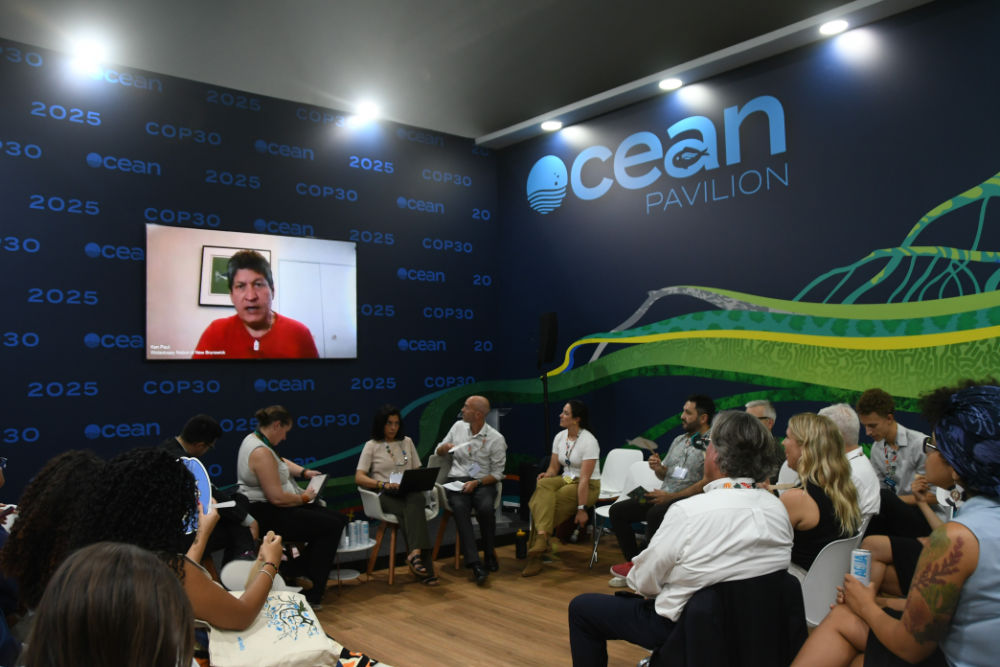
Building on this perspective, the roundtable explored community priorities in the ocean-climate sector, barriers to designing interdisciplinary research projects, key takeaways from successful co-design techniques, and suggestions for how to collaborate more effectively.
The discussion concluded with several clear priorities for advancing co-designed research, including:
- Ensuring communities are included in research discussions, while also providing opportunities and resources to participate meaningfully early in the process
- Building partnerships that foster the exchange of knowledge and technology
- Designing tools to better support community-led projects
- Creating pathways for science and policy to meet communities where they are at
By engaging communities early on in the process, scientists can help build the trust and respect needed to co-design research effectively and ensure solutions align with community priorities.
To learn more about how the CONVERGE CDR program is supporting community engagement in Canada’s emerging mCDR sector, visit: https://www.ofi.ca/impact/converge-cdr.