About the program
The Nippon Foundation-Partnership for Observation of the Global Ocean (NF-POGO) Centre of Excellence in Ocean Observation stands as a pivotal platform for developing the next generation of ocean scientists. By providing comprehensive training, fostering international collaboration, and promoting knowledge sharing, the program prepares scholars to join global efforts in ocean observation and environmental stewardship.
The Centre of Excellence in Observational Oceanography (COE) is a comprehensive training program hosted by the Ocean Frontier Institute (OFI), in partnership with Dalhousie University, the Fisheries and Marine Institute of Memorial University, and the Hakai Institute, and with key curriculum delivery by the International Ocean Institute Canada (IOI-Canada). Throughout the 10-month program, scholars engage in hands-on learning designed to equip early-career scientists with important interdisciplinary skills.
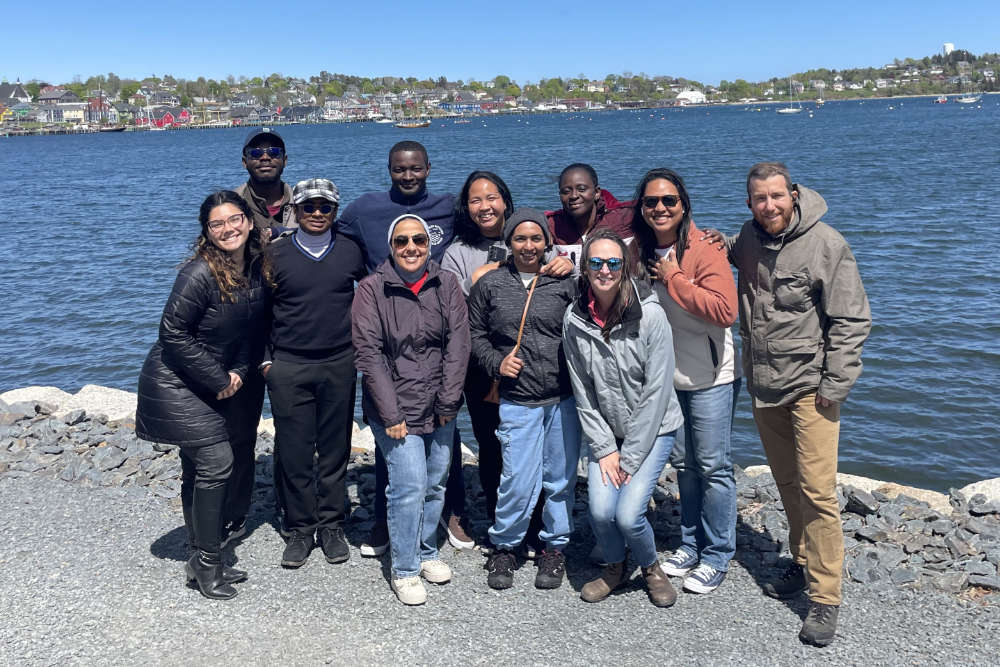
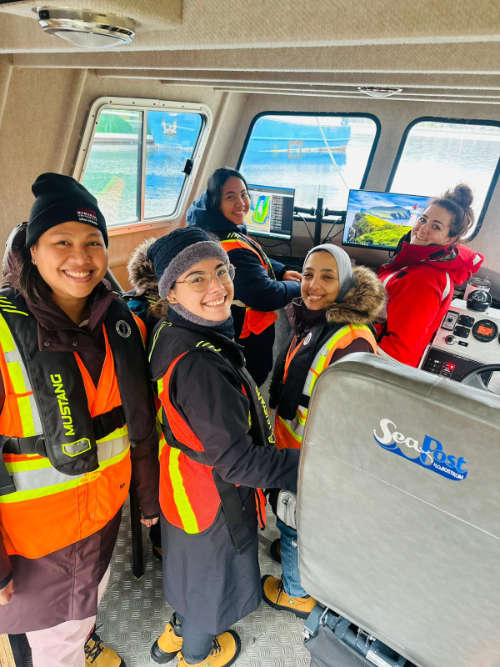
With the launch of the fourth phase of the program, the first in Canada, in September 2024, a group of ten scholars travelled from their home countries of Mexico, Brazil, Senegal, Ghana, Kenya, Egypt, India, Bangladesh, Indonesia, and The Philippines to the Marine Institute in St. John’s, Newfoundland, to start their adventure. Picturesque St. John’s became their home base for the next six months. During this time, the scholars developed essential oceanographic research skills. The course work varied from training at sea, where the scholars embarked onboard a research vessel to apply their newly acquired knowledge, to specialized ocean observation topics such as remote sensing.
“The training in machine learning and processing multibeam data—archival data on the oceans water depth—has been incredibly valuable,”
says Md Shahadat Hossain, COE scholar from Shahjalal University of Science and Technology, Sylhet in Bangladesh. “In the age of AI, knowledge of machine learning is truly an essential skill to have.”
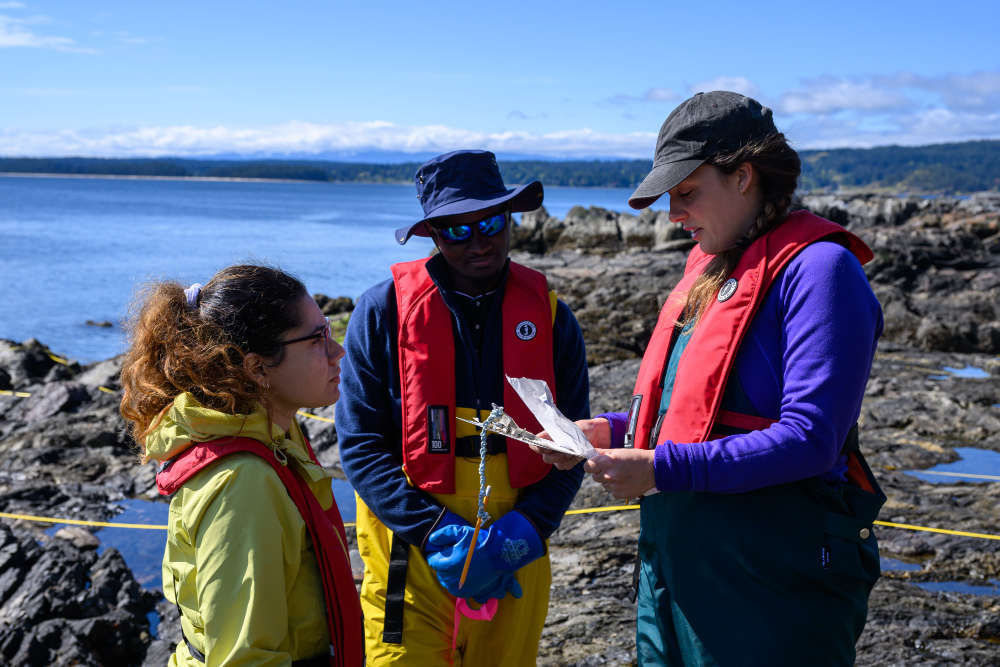
The scholars then travelled to the West Coast for three action-packed weeks with the Hakai Institute, kicking off their time at the Quadra Island Ecological Observatory in British Columbia—nicknamed “The Field School” for good reason. There, they dove into hands-on science: scrambling over tidepools during intertidal biodiversity surveys, peering into microscopes and exploring DNA sequencing during a mini bioblitz, and learning how to use advanced geospatial technology to tell stories about our changing planet. Then tracking north on a foray up the Central Coast to the Hakai Institute’s outpost on Calvert Island, the scholars trekked into rainforests exploring watersheds, and took to the sea with the oceanography crew deploying a buoy and launching an autonomous ocean glider. The experience was a full sensory plunge into coastal science, giving scholars not just technical training but a visceral sense of place—and why this rugged, rain-soaked coastline is one of the most dynamic laboratories for ocean observation on the planet.
For the final two months of the program, the scholars travelled to Dalhousie University in Halifax, Nova Scotia, where the focus shifted to ocean and social science-related topics, including Indigenous Cultural Awareness, science communication, and a five-week intensive module on ocean governance administered by the IOI Canada.
Scholars were also able to engage with industry partners in Halifax to explore industry applications of ocean data. “The few months at Dalhousie University were fascinating as it provided deep insights into the province of Nova Scotia and its unique culture within Canada. As one of my main focus areas is the blue economy, I enjoyed my time at COVE where I was able to explore upcoming marine innovations,” explains Dennis Otieno, COE scholar from the Technical University of Mombasa in Kenya.
During their time at Dalhousie, the ten scholars completed independent learning projects aligned with their interests, focusing on topics related to environmental or socioeconomic ocean sustainability. These projects were designed to showcase and apply knowledge learned in the program and contribute to the scholars' professional development. The current cohort also co-authored an article in the Fisheries and Marine Institute’s Journal of Ocean Technology to share their perspectives on accessible ocean monitoring technologies in developing countries.
Graduates of the Centre of Excellence in Observational Oceanography program have access to a robust network of professionals and institutions in the field of oceanography. These connections will help to facilitate continued collaboration, mentorship, and involvement in international ocean observing initiatives.
“Building on the success of the previous hosts, the NF-POGO Centre of Excellence in Canada, has been an incredible journey for the scholars,” says Tracey Woodhouse, OFI Training and Early Career Development Program Manager.
“Not only have the scholars gained invaluable ocean observation skills and experience across unique Canadian locations, but they’ve also learned from one another, exchanging knowledge and perspectives that span the globe and that will shape their future careers.”
As the first Canadian cohort of this intensive 10-month program winds down, the scholars are reflecting on their next steps as they prepare to graduate on July 31, 2025.
“Moving forward in my career, I plan on pursuing a PhD in fisheries oceanography or related fields that involve the application of observational oceanography. This program will significantly help me achieve these goals from the skills developed and connections that I have made,” says Dennis Otieno.
Punya Puthukulangara, COE scholar from the Indian Institute of Space Science and Technology in India, says
“The program equipped me with the technical and analytical skills essential for impactful climate-related ocean research. I aim to advance my research on climate change modelling of oceans and marine ecosystems by incorporating the knowledge and skills gained throughout the program.”
After an inspiring and successful year, the Centre of Excellence in Observational Oceanography is set to welcome the next cohort of scholars this fall. Check back soon for updates from this exciting program!