When we study ocean productivity and the carbon cycle, one group of tiny organisms is the foundation of these processes: phytoplankton. Using energy from the sun, phytoplankton convert carbon dioxide into biomass and oxygen, a key process in the regulation of our climate. Different groups of phytoplankton, such as diatoms, dinoflagellates and coccolithophores, all have various traits and ecology affecting their growth and reproduction. In the Labrador Sea, large spring blooms of phytoplankton are common. Knowledge of phytoplankton species and abundance is important for understanding how environmental conditions such as nutrients and light may be driving the productivity of the bloom, and what might happen to the biomass produced.
Phytoplankton are consumed by zooplankton, whose diversity also shapes the fate of the blooms. Zooplankton include small crustaceans such as copepods and krill, gelatinous organisms such as jellies, or even single cell organisms like dinoflagellates. They release particles through excretory processes (e.g., feces) and grazing. Some of these particles sink to the deep ocean and ultimately fall to the ocean floor, contributing to ocean carbon storage by removing this carbon from contact with the atmosphere. Thus, understanding zooplankton community composition is crucial for understanding both marine food webs and the ocean carbon cycle.
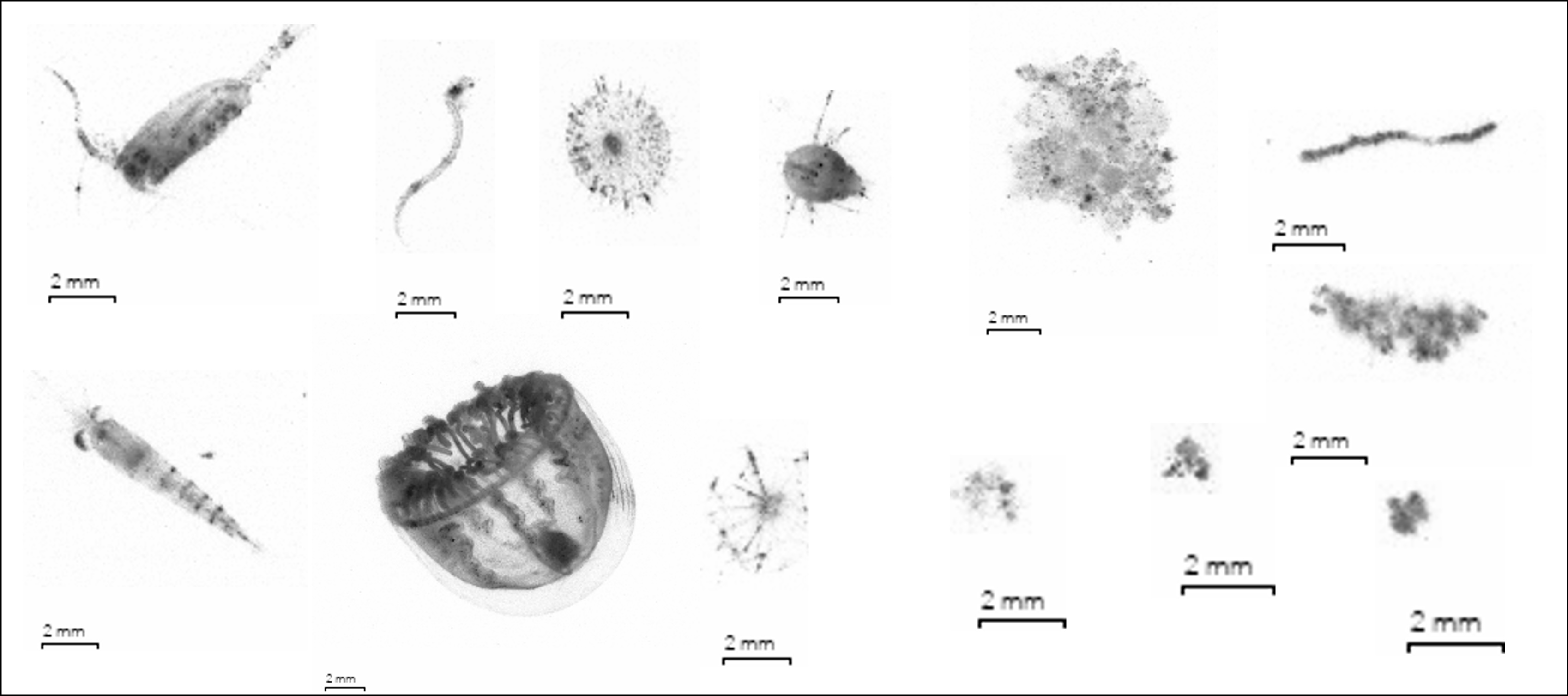
During the AZOMP/ADOCCS research mission, many of the scientists on board were involved in sampling related to the physical and chemical conditions impacting phytoplankton blooms and zooplankton grazing, as well as sampling directly related to plankton biology. Imaging systems are one way to study plankton communities at sea. The resolution of these instruments can range from detecting phytoplankton only a few microns in length, to larger organisms like zooplankton and marine particles up to a few millimeters in size. On board the L’Atalante, our team deployed two imaging systems to investigate the microscopic life inhabiting the water column: the Imaging FlowCytobot (IFCB) and the Underwater Vision Profiler 6 (UVP6). These instruments give complementary views on different sizes of particles and organisms in the planktonic realm.
Imaging phytoplankton with the IFCB
Élodie Gagnon and Carole-Anne Guay, from the Takuvik team at Université Laval in Québec, used an IFCB to continuously monitor phytoplankton and small zooplankton communities during the mission. This sampling provided images that can be used for identifying species and estimating abundance of plankton in different areas across the Labrador Sea. The IFCB captured high-resolution images of individual phytoplankton cells in near real-time by analyzing seawater continuously pumped from just below the ocean surface while the ship was moving. To extend observations deeper into the water column, they also collected water samples from the CTD rosette, a classic oceanographic instrument which profiles the water column and allows for water collection at various depths. These samples will be compared with those from the IFCB to allow for examining phytoplankton composition and abundance both vertically and horizontally in space and time.
Profiling large plankton and particle abundance with the UVP6
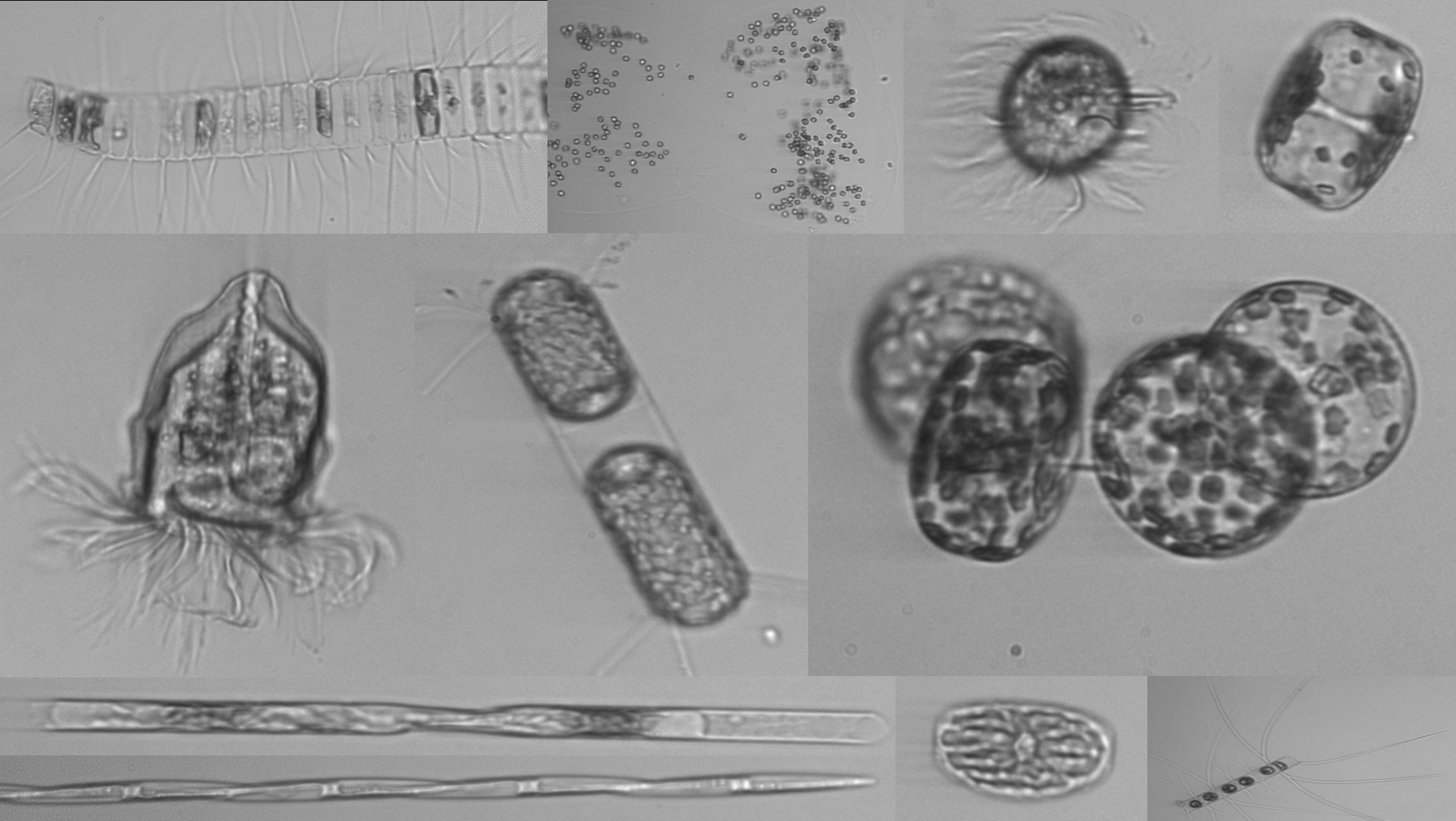
Manon Laget from Dalhousie University in Halifax led the UVP6 sampling. The instrument was mounted on the CTD rosette and deployed down to the bottom of the Labrador Sea at various locations. As it descends through the water column, the UVP6 emits red light while capturing high-frequency images of particles and organisms larger than 600 µm (which is a fraction of a millimeter). Examples include zooplankton, large phytoplankton such as Phaeocystis colonies (common in the Labrador Sea), fecal pellets, and aggregates of detritus known as marine snow. A one-month research cruise can generate about a million images, which are subsequently processed using machine learning algorithms and manual classification. These images allow us to assess the diversity and distribution of the zooplankton, as well as the abundance of fecal pellets and phytoplankton detritus (marine snow), which are key components of the biological carbon pump and carbon sequestration.
Building a global, standardized dataset
Datasets from previous years will enable temporal comparisons and help identify changes and trends in the Labrador Sea. Additionally, both instruments are now widely used in oceanographic research, and consistent deployments have made it possible to build global, standardized datasets. The data we collected on this expedition will contribute to these efforts, helping to improve our understanding of ocean ecology and biogeochemistry on a global scale and how organisms such as phytoplankton are responding to environmental changes. The taxonomy, life history and ecology of plankton is still very much a mystery in marine science, and imaging systems can provide a unique snapshot of these vital species.
About Manon Laget
Manon Laget is a postdoctoral fellow at Dalhousie University in Halifax, Nova Scotia. Originally from France, Manon studies how the properties of particles produced during the spring bloom shape the biological carbon pump in the Labrador Sea — and, in turn, the ability of this region to store carbon.