Tom Spencer-Hicken spent much of his childhood visiting the world-famous Dolphin Beach—a benefit of growing up in Cape Town, South Africa. But he admits it never occurred to him to consider a career in oceanography until he began his post-secondary studies.
“My focus was biodiversity and conservation biology because I was passionate about nature, and one of my professors happened to be an oceanographer,” explains Spencer-Hicken. “His course focused on ocean dynamics and how they influence what happens around the world. That sparked my curiosity, so I applied to do my master’s degree in oceanography.”
The Nippon Foundation-Partnership for Observation of the Global Ocean (NF-POGO) Centre of Excellence in Observational Oceanography (COE) program provided Spencer-Hicken with an opportunity to explore the field even further. Hosted by OFI, in partnership with Dalhousie University, the Fisheries and Marine Institute of Memorial University, the Hakai Institute, and key curriculum delivery partner the International Ocean Institute of Canada, this 10-month program builds skills for championing ocean observation globally.
“I wanted to see what is happening that is innovative in data collection and modelling with the hopes of bringing some of that back to South Africa.”
Stepping out of his comfort zone
Spencer-Hicken’s research focus is coastal upwelling and its impact on marine life. During his studies in South Africa, he investigated the influence of the Benguela upwelling system on west coast communities and fishing operations. As a COE scholar, he has studied the influence of Kelvin waves along the coast of Newfoundland with Dr. Frédéric Cyr.
"The driving mechanism of upwelling in South Africa is Ekman transport driven by the summer trade winds, whereas in Newfoundland, it is these subsurface waves driven by high wind storms,” Spencer-Hicken says. “It’s a drastically different coastline with different mechanisms so it took me out of my comfort zone.”
As part of the program, Spencer-Hicken has also been collaborating with the other COE scholars on the development of a framework to assess the accessibility of ocean data shared by countries globally.
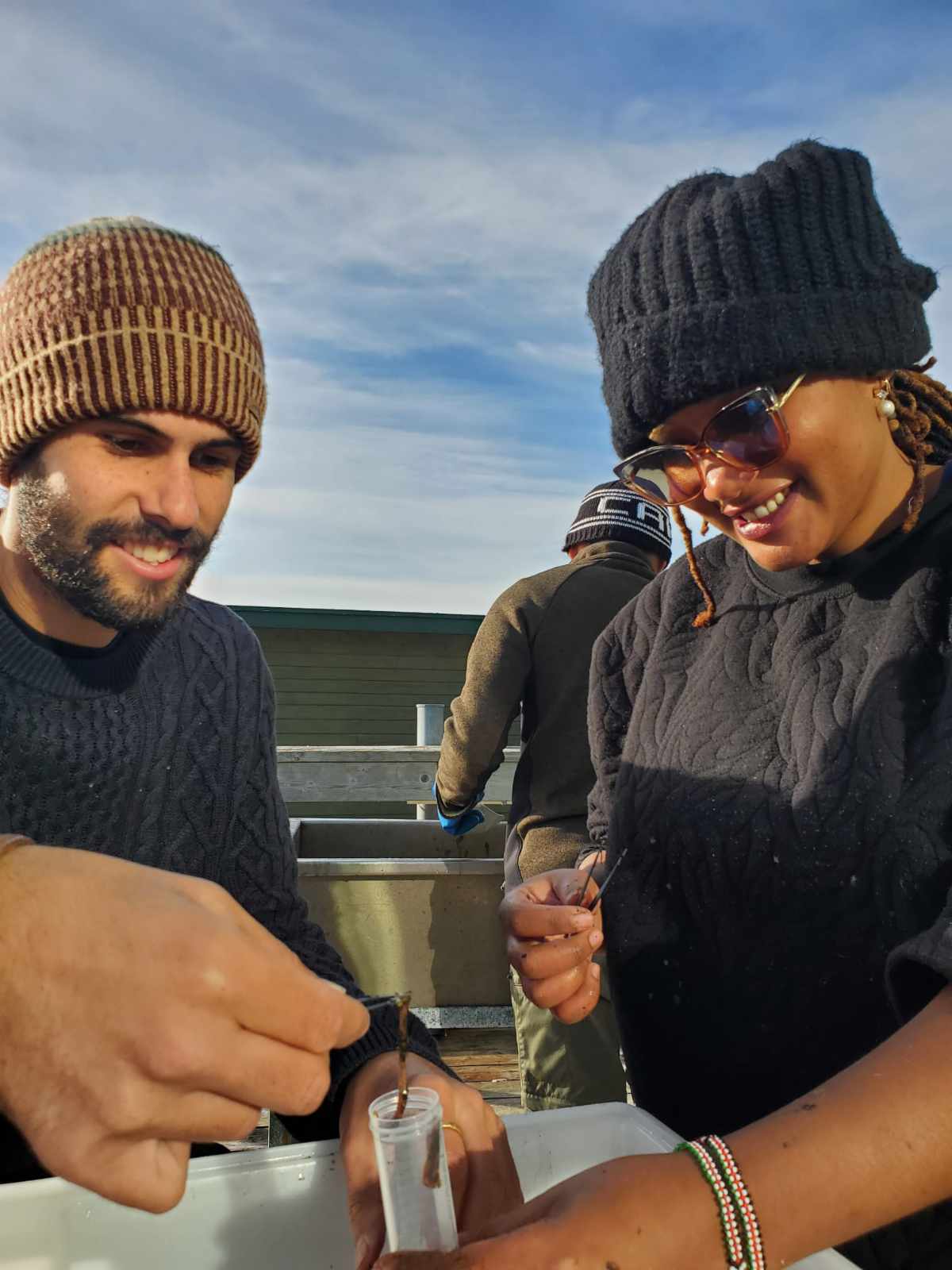
The program also gave Spencer-Hicken hands-on experience using ocean observation equipment. At the Fisheries and Marine Institute, he deployed conductivity, temperature, and depth equipment, crab traps, and a grab sampler in Bonne Bay. He also gained experience with side-scan sonar, single-beam and multibeam echosounders, and autonomous underwater vehicle mission planning in Holyrood.
“We were able to pilot remotely operated vehicles in Holyrood and in the flume tank of the Marine Institute,” Spencer-Hicken says. “We were also able to pilot those vehicles using simulators.”

Invaluable knowledge and connections
As his time in the program winds down, Spencer-Hicken is thinking about his future. He plans to return to South Africa to continue his upwelling research. He is also interested in exploring opportunities for international collaborations to help position South Africa at the forefront of ocean research.
“I want to find more opportunities to gain experience in new or advanced technologies and see how we can implement them successfully,” Spencer-Hicken says.
“It’s all knowledge that is developing in South Africa, but I think I can further that effort through the connections I’ve made in this program.”